



Latest Environmental Sustainability
News at UW-Stout

WorldCafe12
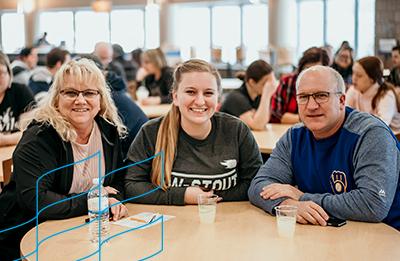
Faculty and Staff of UW-Stout take part in world café event
Janury 21, 2010

Faculty and staff of UW-Stout took part in world café event, a series of small-group conversations, devoted to incorporating sustainability into the curriculum.  Faculty in areas such as Business, Construction, Biology, Industrial Design, Engineering & Technology, Hospitality and Tourism, Psychology, English, and Art looked at ways to infuse sustainability principles into their courses.  Participants discussed current sustainability issues at UW-Stout and how these issues can be integrated into the curriculum. 

The event was hosted by UW-Stout faculty members Krista James, Anne Hoel, Joan Menefee, and Susan Staggs.  Mary McManus facilitated the discussions.

This event helped faculty and staff prepare for a two-day workshop that UW-Stout is sponsoring on May 25-26 entitled “Infusing Sustainability into the Curriculum”.  This workshop will be open to faculty and staff at institutions of higher education.  Additional information on this event can be found at Sustainability: Infusing Sustainability into the Curriculum.

WorldCafe7


The UW-Stout Sustainability Across the Curriculum Initiative planning committee is hosting a World Café event
9 a.m. to 1 p.m., Thursday, Jan. 21, during professional development week.

A World Café is an innovative yet simple way of hosting conversations about questions that matter to the topic at hand. Participants move from table to table, continually meeting with new people to keep the discussions fresh. Participants will discuss sustainability issues at UW-Stout and how these issues can be integrated into the curriculum.

The planning committee’s goal is to include teaching faculty from every academic department. So far, representatives from the following departments have confirmed their attendance:  Apparel and Communication Technologies, Biology, Business Administration, Chemistry, Construction, Engineering and Technology, English, Military Science, Operations and Management, Physics, Psychology and Social Science.

If your department is not represented and this is something of interest to you, contact Krista James via e-mail to register. A participant count is needed to ensure enough beverages and food for all.


UW-Stout Dining Services Goes Green with Compostable Packaging
November 6, 2009

UW-Stout’s University Dining Services started the 2009 fall semester by switching to commercially compostable packaging for all food and beverages served in disposable containers.  Currently, 100% of the products used in Stout’s Residence Dining Halls for take-out food are compostable.  In the University’s nine dining retail operations, over 80% of the packaging has been replaced with materials that are compostable.  This includes cutlery, hot and cold cups and lids, plates, hot and cold bowls, straws, and clamshells (a type of packaging, often consisting of two parts attached by a hinge and that open and close like a clamshell.)  The remaining 20% of packaging will be changed to compostable items just as soon as solutions can be discovered.
While the compostable products will be approximately twice the cost of petroleum-based Styrofoam and plastic, the production uses less energy than traditional counterparts and produces less CO2.  Using a program developed by the primary supplier of compostable packaging, UW-Stout estimates savings of 2,755 gallons of gasoline and 27,146 pounds of greenhouse gases.
Stout’s University Dining Services has been making steady inroads into making their operations more sustainable.  They recently determined that 37 percent of their $1.58 million annual food budget is spent on items from Wisconsin food-production companies, reducing the distance the food travels and reducing its environmental impact.  They’ve also invested in energy efficient appliances and use green chemicals for manual and machine washing.  The switch to compostable packaging came about after extensive research into the market of food packaging and included locating the right products to meet needs without sacrificing customer satisfaction. 
The new materials are made of resources that are renewable and biodegradable.   The materials being used in the new packaging are:

•    PLA (polylactic acid) or “corn plastic” – made from corn starch or sugarcane
•    Bagasse (sugarcane) - a reclaimed resource traditionally thrown away which is the stalk of sugar cane after sugar juice is extracted
•    Other plant starches

In order to complete the composting cycle with packaging and department food waste entering the commercial composting waste stream, UW-Stout has begun searching for an outlet for food waste and commercially compostable packaging products.  The department is currently working with Veolia, the campus waste hauler, to educate community foodservice professionals about the ability to begin compostable pick-ups at foodservice establishments in Menomonie.  Such a service is already underway in Eau Claire foodservice establishments.  Should this be secured for Menomonie, the cycle for these new products and departmental waste will be complete and benefits to the environment enhanced.


Dining Services Participates in Million Gallon Challenge
November 4, 2009

University Dining Services is participating in Eco-Products Million Gallon Challenge.  By using earth friendly foodservice containers, the University has saved 2,755 gallons of gasoline and 27,146 pounds of greenhouse gases in the last year.  This is the equivalent of driving a new car 33,796 miles, or having saved 81 trees. 
The Eco-Products Million Gallon Challenge is a campaign demonstrating how customers help the environment and save energy when using food service items utilizing earth-friendly materials.  The goal is to count energy savings up to one million gallons of gasoline.


UW-Stout to hold Recyclable Art Competition 
November 2, 2009

Children and adults all over Dunn County will soon be able to turn their recyclables into artwork with the possibility of being rewarded for their efforts. The University of Wisconsin-Stout in Menomonie is hosting the third annual Recyclable Art Competition from 6-8 p.m., Thursday, Nov. 12, in the Great Hall of the Memorial Student Center.

“This community-wide event has something for everyone: creative art, local entertainment and fun, interactive, educational games and activities,” Krista James, event organizer and UW-Stout biology lecturer, said.

Artwork will be judged in four age categories: elementary school students, middle school students, high school students and adults age 18 and older. Two prizes will be awarded for each category: Popular Choice and Judge’s Choice.

All art entries must be made from recyclable materials. All participants must deliver their artwork in person between 5:30-6 p.m., and must stay until 8 p.m., when winners are announced and photographs are taken.

The event is sponsored by Dunn County Solid Waste, Sustainable Dunn, Greater Menomonie Area Community Foundation, West Wisconsin Land Trust and UW-Stout organizations and programs including GreenSense, Stout Student Association, Inter-Residence Hall Association, University Honors Program, the Environmental Sustainability Office and the departments of biology, art and design, and recreation.


UW-Stout’s “Don’t Blow the Bulb” places third in energy competition
October 2, 2009

University Housing at the University of Wisconsin-Stout in Menomonie has won third place in the 2009 Best Practices Awards competition held by the Central Association of College and University Business Officers.

University Housing was recognized for its “Don’t Blow the Bulb” Residence Hall Energy competition, which it held in March. The competition pitted hall residents against each other in finding the simplest and best ways to reduce energy consumption. The hall with the largest percentage decrease in electricity usage received a pizza party during finals week.

The competition was sponsored by Stout@Hand, which is a sub-committee of UW-Stout’s Inter-Residence Hall Association — a student organization dedicated to representing all the students who live in the residence halls. The committee discovered that simple changes in daily habits, such as turning off lights when rooms were unoccupied and unplugging appliances when not in use, had a large cumulative effect.

To kick off the competition, students invited representatives from the university’s Physical Plant to teach them about different types of energy such as electricity, water, waste and recycling materials. They also learned about the ways in which different types of energy are measured.

Since electricity usage is measured in kilowatts and is easy to convert to cost savings, the students had goals of reducing electricity usage as well as reducing costs. Overall, the residence halls reduced electricity usage during the contest month by almost 6 percent across the Residence Hall System, saving a total of 23,885 kilowatts or $2,329.

The award will be presented to a UW-Stout representative at an annual conference in Cincinnati Oct. 6. The third place award is a plaque and a check for $500.

This is the second time UW-Stout has won an award for best practices. In 2008, the Physical Plant also placed third for its Enhanced Safety Awareness Program.


(back to top)